Water filtration systems can be confusing—especially when terms like 2-stage, 3-stage, softener,brine tank and ion exchange are used interchangeably.
At BBS, we focus on keeping things simple:
Understand the water first, then design the system properly
What Does “Stage” Actually Mean?
A stage refers to a filter tank (FRP vessel).
- 2-stage = 2 filter tanks
- 3-stage = 3 filter tanks
The brine tank is NOT a stage
It only supports the softener (ion exchange system)
What is a Softener (Ion Exchange)?
A water softener uses a process called ion exchange to remove hardness (calcium and magnesium).
- Prevents scaling in pipes, heaters, and taps
- Improves water feel (less “dry” on skin)
The brine tank (salt tank) is used to regenerate the system so it keeps working.
Common System Configurations
2-Stage System (Simplified Setup)
Option A: Sand + Softener
- Removes dirt and sediment
- Removes hardness
Good for: dirty or bore water
Limitation: no odor or chlorine removal
Option B: Carbon + Softener
- Removes odor, chlorine, organics
- Removes hardness
Good for: PDAM / treated water
Limitation: less protection from sediment
With a 2-stage system, you are choosing which issue to prioritise—sediment or odor.
3-Stage System (Recommended Setup)
- Stage 1: Sand filter → removes dirt and particles
- Stage 2: Carbon filter → removes odor, chlorine
- Stage 3: Softener (resin) → removes hardness
- Brine tank (for regeneration)
This is the most complete and balanced system
Why a 3 - Stage System is Better
1. Protects the Softener
Resin is sensitive to dirt and chlorine.
A proper pre-filtration setup extends its lifespan.
2. Better Water Quality
You get:
- Clean water (no sediment)
- No smell
- Soft water
3. Lower Long-Term Costs
- Less maintenance
- Longer equipment life
- Fewer replacements
4. Ideal for RO Systems
If you plan to install a drinking water RO system, pre-filtration is critical.
3-stage protects:
- RO membrane
- Overall system performance
Why Water Testing is Important
Every water source is different. A proper system should be based on actual water analysis, not guesswork.
What we look for:
- Turbidity (dirt/particles) → Sand filter
- Chlorine / odor → Carbon filter
- Hardness → Softener
- Iron / manganese → Specialised media
- TDS → Determines if RO is needed
Real-World Examples
Typical Bali Bore Water
- Sediment
- Odor
- Hardness
Solution: 3-stage (Sand + Carbon + Softener)
PDAM / City Water
- Low sediment
- Chlorine present
- Moderate hardness
Solution: 2-stage (Carbon + Softener)
Clean but Hard Water
- No smell
- Low sediment
- High hardness
Solution: Softener only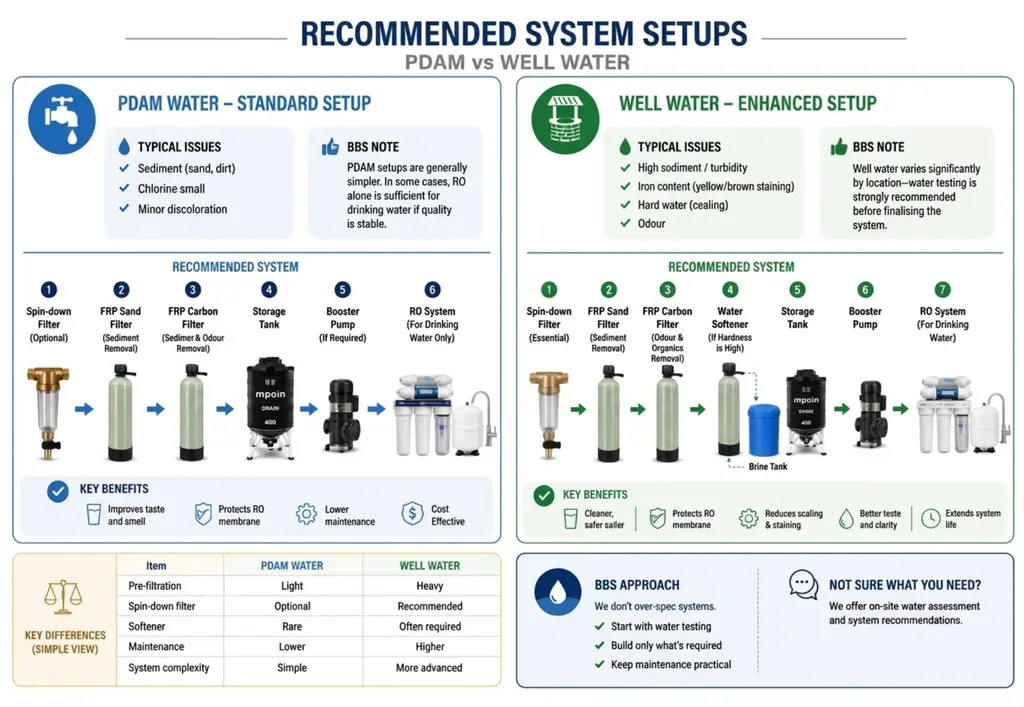
Common Mistake
Many systems are installed without proper testing or understanding.
Result:
- Poor performance
- Short lifespan
- Unnecessary costs
At BBS, we don’t sell “standard packages” blindly. We assess the water conditions and recommend a system where each stage has a clear purpose.
- Stages = filter tanks only
- Softener = ion exchange system (requires brine tank)
- 2-stage = compromise system
- 3-stage = complete solution
- Water testing = key to getting it right