In Bali, lightning strikes are part of everyday life—especially during the rainy season. With tropical storms, high humidity, and many buildings exposed on open land or coastal areas, lightning protection is not optional. It is a critical safety system for any villa, warehouse, hotel, or commercial building.
A lightning protection system does not prevent lightning. Instead, it controls where lightning goes and safely directs it into the ground.
The Basic Principle
Lightning always seeks the shortest and easiest path to earth.
If a building does not provide a safe path, lightning will create its own—through roofs, concrete, steel reinforcement, electrical wiring, or plumbing. This can cause structural damage, equipment failure, fire, and serious safety risks.
A lightning protection system provides a controlled, low-resistance route that safely carries lightning energy into the ground.
The Three Main Components
1. Lightning Rod (Air Terminal)
Installed at the highest point of the building—typically on the roof—the lightning rod:
- Intercepts a lightning strike
- Protects the structure by becoming the preferred strike point
It does not “attract” lightning. It simply provides a safer and more controlled point of contact.
2. Down Conductor
From the lightning rod, a copper conductor—commonly BC 35 mm²—runs down the building.
Its role:
- Carries lightning current safely downward
- Keeps energy away from walls, rooms, and electrical systems
For safety, the conductor must be continuous, securely fixed, and routed with minimal bends. Sharp turns or loose connections increase resistance and reduce effectiveness.
3. Grounding System
At ground level, the system connects to earthing rods driven deep into the soil.
Its role:
- Disperses lightning energy into the earth
- Prevents energy from re-entering the building
For a lightning system to function properly, the grounding system must have low electrical resistance, typically less than 5 ohms (< 5 Ω).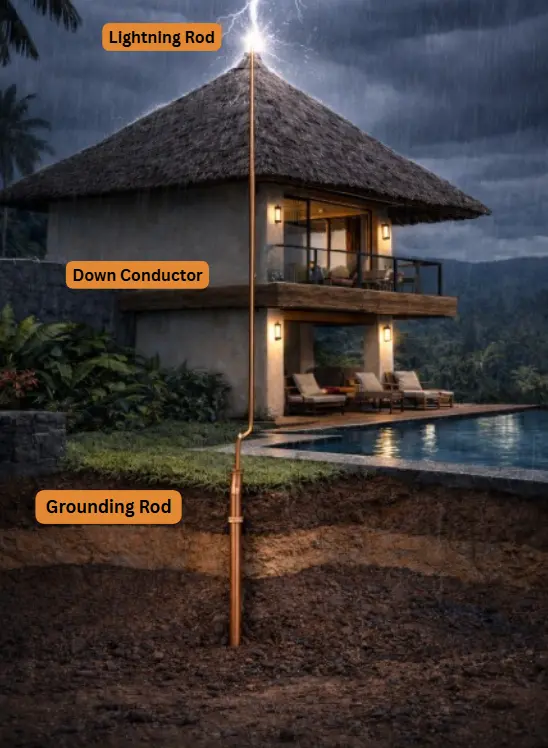
What Is Ground Resistance Testing?
Ground resistance testing measures how easily electrical energy can flow from the grounding system into the earth.
In simple terms:
- Low resistance = lightning energy flows safely into the ground
- High resistance = lightning energy may return into the building
Visual inspection alone cannot confirm this. Testing is essential.
How Ground Resistance Testing Is Done
Step 1: Visual Inspection
Technicians check:
- Lightning rod condition
- Copper conductor continuity
- Visible grounding connections
This confirms the system appears complete before testing begins.
Step 2: Continuity Check
A basic electrical test verifies:
- The lightning rod is electrically connected to the grounding system
- There are no breaks in the conductor
This confirms the path exists—but not whether it is effective.
Step 3: Earth Resistance Measurement
A dedicated earth resistance tester is used—not a standard multimeter.
During testing:
- Temporary probes are placed in the soil at measured distances
- A small electrical current is injected into the ground
- Voltage drop is measured
- Resistance is calculated in ohms (Ω)
This determines whether the grounding system meets safety standards.
Step 4: Interpreting the Results
- < 5 Ω → Effective and acceptable
- 5–10 Ω → Marginal; improvements recommended
- > 10 Ω → Unsafe; corrective work required
If resistance is too high, solutions may include:
- Adding additional earthing rods
- Increasing rod depth
- Improving soil conductivity
Why Ground Testing Is Critical in Bali
Bali’s soil conditions vary widely:
- Volcanic soil
- Limestone areas
- Sandy coastal zones
During the dry season, soil moisture drops significantly—often increasing ground resistance.
A lightning system that worked last year may not be safe today. Periodic testing ensures continued protection.
A Common Mistake
Many buildings in Bali have lightning rods installed but:
- No visible earthing point
- No test records
- No confirmation the system actually works
A lightning rod without tested grounding provides false security.
Final Summary
A lightning protection system works by:
- Intercepting lightning at the roof
- Carrying energy safely downward
- Releasing it into the earth through a tested grounding system
Ground resistance testing confirms the system can actually perform as intended.