What is reverse osmosis (RO)?
Reverse osmosis (RO) is a filtration process that removes dissolved solids, contaminants, and impurities by forcing water through a semi-permeable membrane. It produces clean, safe drinking water by filtering out particles too small for standard filtration.
How does a BBS 6-stage RO system work?
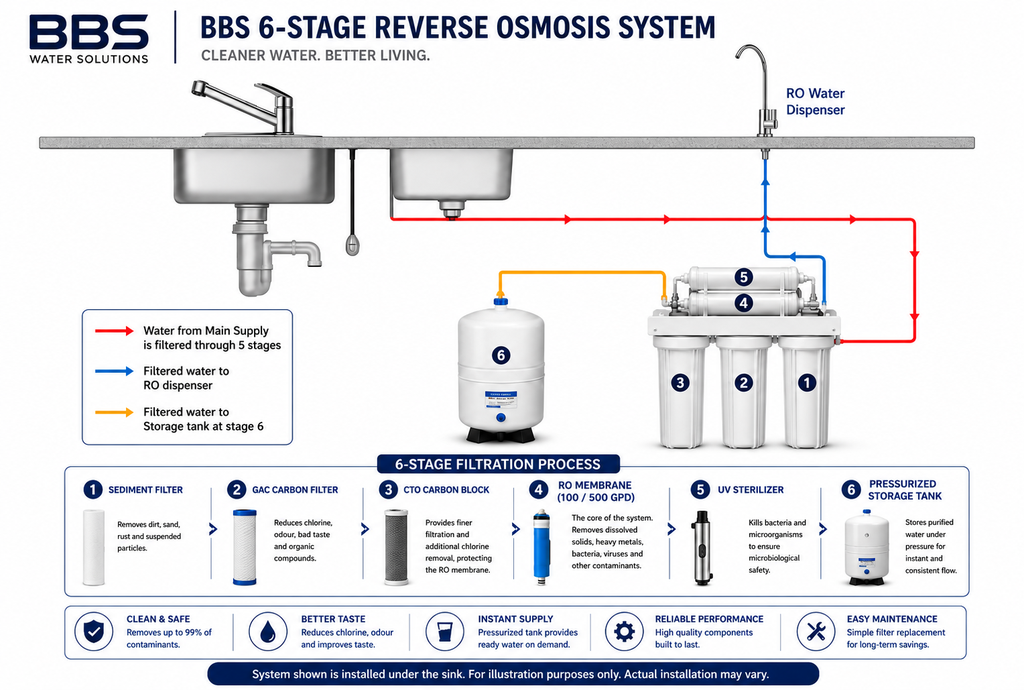
Your system includes:
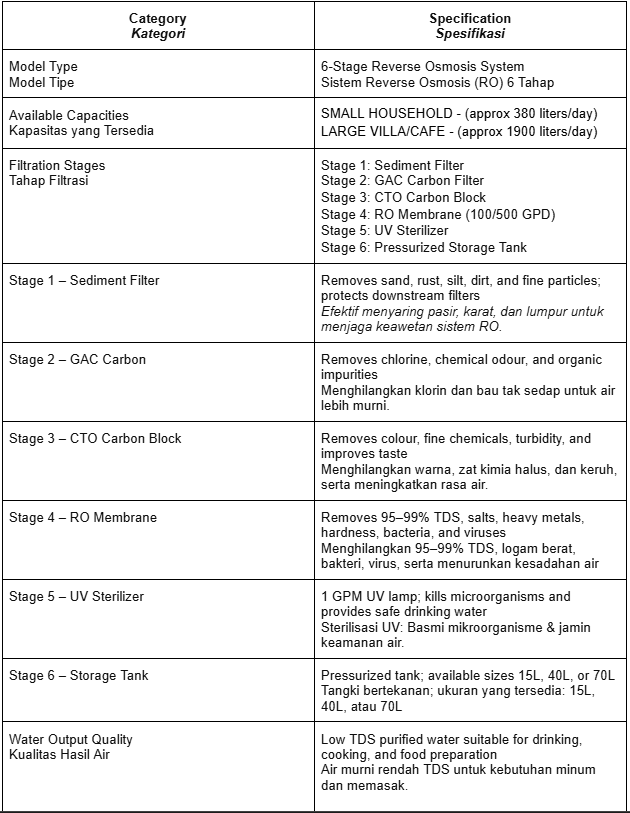
- Sediment Filter – removes dirt, sand, and particles
- GAC Carbon Filter – removes chlorine, odour, and organics
- CTO Carbon Block – finer filtration and additional chlorine removal
- RO Membrane (100 / 500 GPD) – removes dissolved contaminants
- UV Sterilizer – kills bacteria and microorganisms
- Pressurized Storage Tank – stores filtered water for use
Each stage protects the next, ensuring consistent water quality.
What does the RO membrane actually do?
The RO membrane is the core of the system.
It removes:
- Dissolved salts (TDS)
- Heavy metals
- Chemicals
- Bacteria and viruses
This is where the main purification happens.
What is the difference between 100 GPD and 500 GPD?
GPD = Gallons Per Day (production capacity)
Type | Typical Use |
100 GPD | Standard homes / villas |
500 GPD | High usage / cafés / commercial |
- 100 GPD → lower output, more compact
- 500 GPD → higher output, faster production
Both provide the same water quality, only the volume differs
How do I choose between 100 GPD and 500 GPD?
- 1–4 people / standard villa → 100 GPD
- High usage / multiple users / commercial → 500 GPD
BBS will size this based on actual usage to avoid underperformance.
What does each filter stage do?
- Sediment: protects system from dirt
- GAC Carbon: removes chlorine and smell
- CTO Carbon: finer filtration and polishing
- RO Membrane: removes dissolved contaminants
- UV: ensures microbiological safety
- Tank: maintains usable water supply
Apakah sistem RO 6 tahap cukup?
Yes. This configuration is suitable for most homes, villas, and small commercial use. Additional stages are only required if water testing identifies a specific issue.
Do I need pre-filtration (FRP system)?
Depends on water source:
- PDAM: RO alone may be sufficient
- Well water: Pre-treatment is usually required
Pre-filtration protects the RO membrane and reduces maintenance.
Where is the RO system installed?
At point-of-use, typically:
- Kitchen sink
- Bar / prep area
It is used for drinking and cooking water only.
Does RO reduce water pressure?
RO systems produce water slowly, which is why a pressurized storage tank is included to provide usable flow.
Does the system waste water?
Yes, some water is rejected during filtration.
Efficiency depends on:
- Water quality
- System setup
How often does maintenance need to be done?
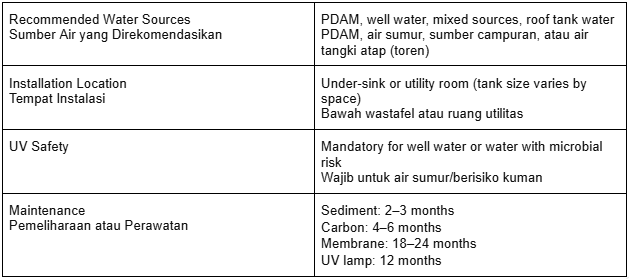
- Sediment & carbon filters: 6–12 months
- RO membrane: 1–2 years
- UV lamp: annually
What happens if the system is not maintained?
- Reduced water quality
- Lower flow
- Membrane damage
- Increased long-term cost
Do I need a water test first?
Recommended. It ensures the correct system size and avoids unnecessary upgrades or performance issues.
BBS Approach
- Test the water first
- Recommend only what’s required
- Match system size (100 vs 500 GPD) to real usage
- Keep maintenance simple and practical