Choosing tiles isn't simply about finding the right colour or pattern. The material itself determines how the surface looks, performs, ages and needs to be maintained.
Porcelain, sintered stone, clay, cement and natural stone can all be excellent choices, but they suit different applications. A highly consistent porcelain tile may be ideal for one project, while the natural variation of limestone or handmade clay may be exactly what another design needs.
Understanding the differences before choosing can help avoid selecting a beautiful material that isn't suited to its intended location
Porcelain Tiles
Porcelain is a type of ceramic manufactured from refined clay and other mineral materials that are fired at very high temperatures. This produces a dense, hard tile with very low water absorption.
Modern porcelain can reproduce the appearance of marble, limestone, terrazzo, concrete, timber and many other materials with impressive detail. It is also available in a huge range of sizes, colours, textures and surface finishes.
This combination of performance, choice and relatively easy maintenance makes porcelain one of the most versatile tile materials available.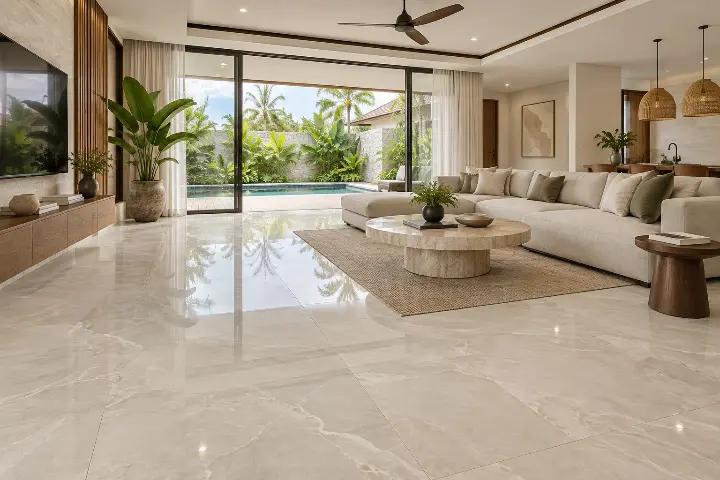
Advantages
- Very low water absorption
- Good stain resistance
- Hard-wearing and durable
- Relatively easy to maintain
- Huge choice of colours and designs
- Natural stone, concrete and timber-look options
- Suitable for many interior and exterior applications
- Available in different slip-resistance finishes
- Generally consistent between tiles
The main consideration is that porcelain is a manufactured product. While premium products can reproduce natural materials extremely well, they don't have the genuine mineral variation or individuality of natural stone.
For exterior and wet areas, the surface finish and slip rating should also be checked rather than assuming that every porcelain tile is suitable.
Best suited to: bathrooms, kitchens, living areas, commercial floors, terraces and general-purpose flooring.
Sintered Stone
Sintered stone is manufactured from selected natural mineral materials that are subjected to extremely high pressure and temperature. The process creates a dense, low-porosity surface with excellent resistance to heat, stains and everyday wear.
One of its major advantages is format. Sintered stone can be manufactured as very large slabs, allowing designers to create surfaces with fewer joints than conventional tiles.
It can reproduce marble, limestone, concrete and other architectural finishes while providing much greater consistency than the natural materials it imitates.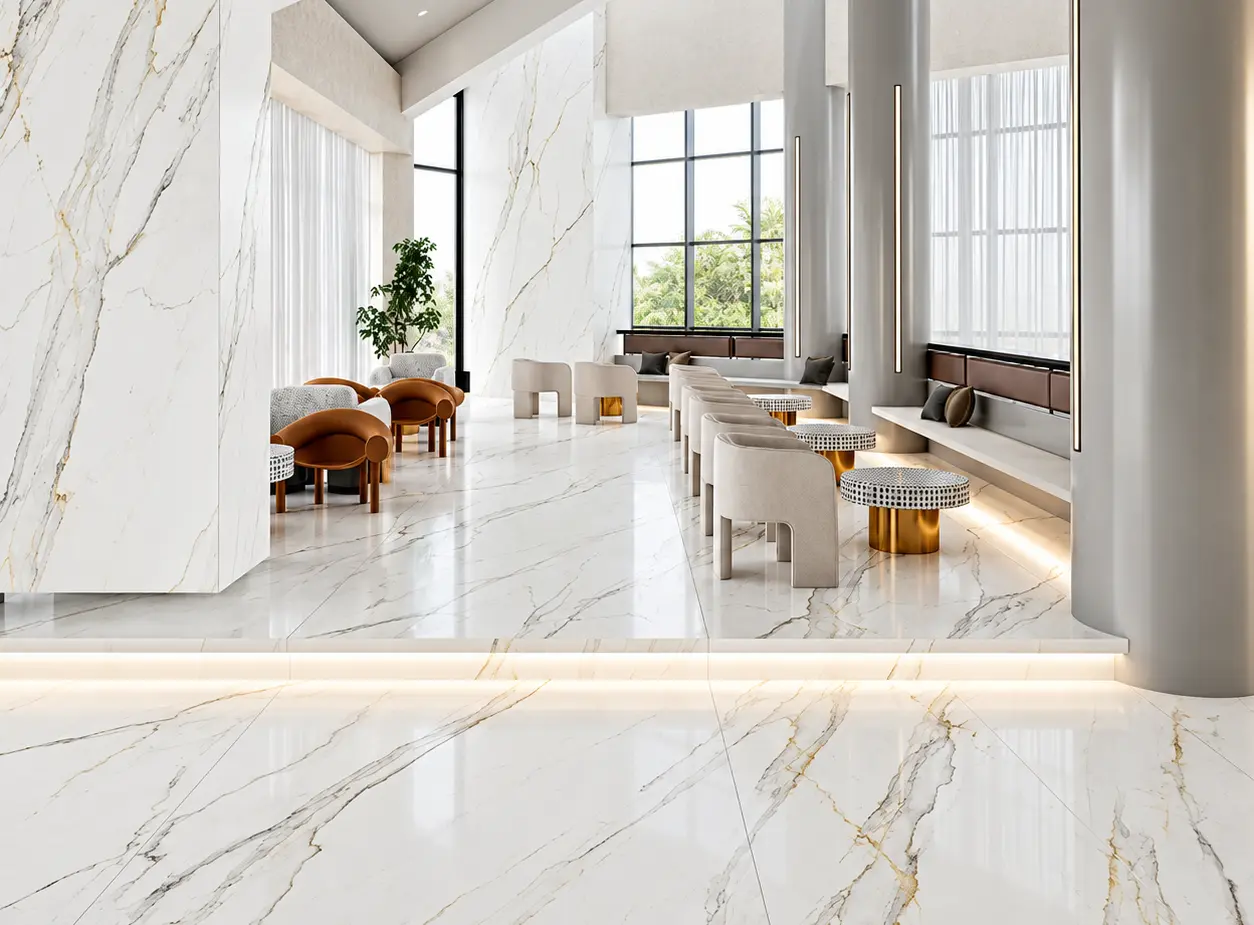
Advantages
- Very low porosity
- Excellent stain resistance
- High heat resistance
- High scratch and abrasion resistance
- Large-format slabs available
- Consistent colour and appearance
- Suitable for floors and walls
- Can also be used for countertops and furniture
- Low routine maintenance
Large slabs require specialist transportation, cutting, handling and installation. The installation cost can therefore be more significant than the material price alone suggests.
Best suited to: contemporary villas, large-format walls and floors, bathrooms, façades, countertops and architectural feature surfaces.
Clay & Terracotta Tiles
Clay tiles are among the oldest forms of architectural flooring. Natural clay is formed into tiles and fired in a kiln, with terracotta being one of the most recognisable examples.
Where porcelain and sintered stone aim for manufacturing precision, traditional clay tiles often celebrate the opposite.
Subtle variations in dimensions, edges, texture and colour give the finished floor its character.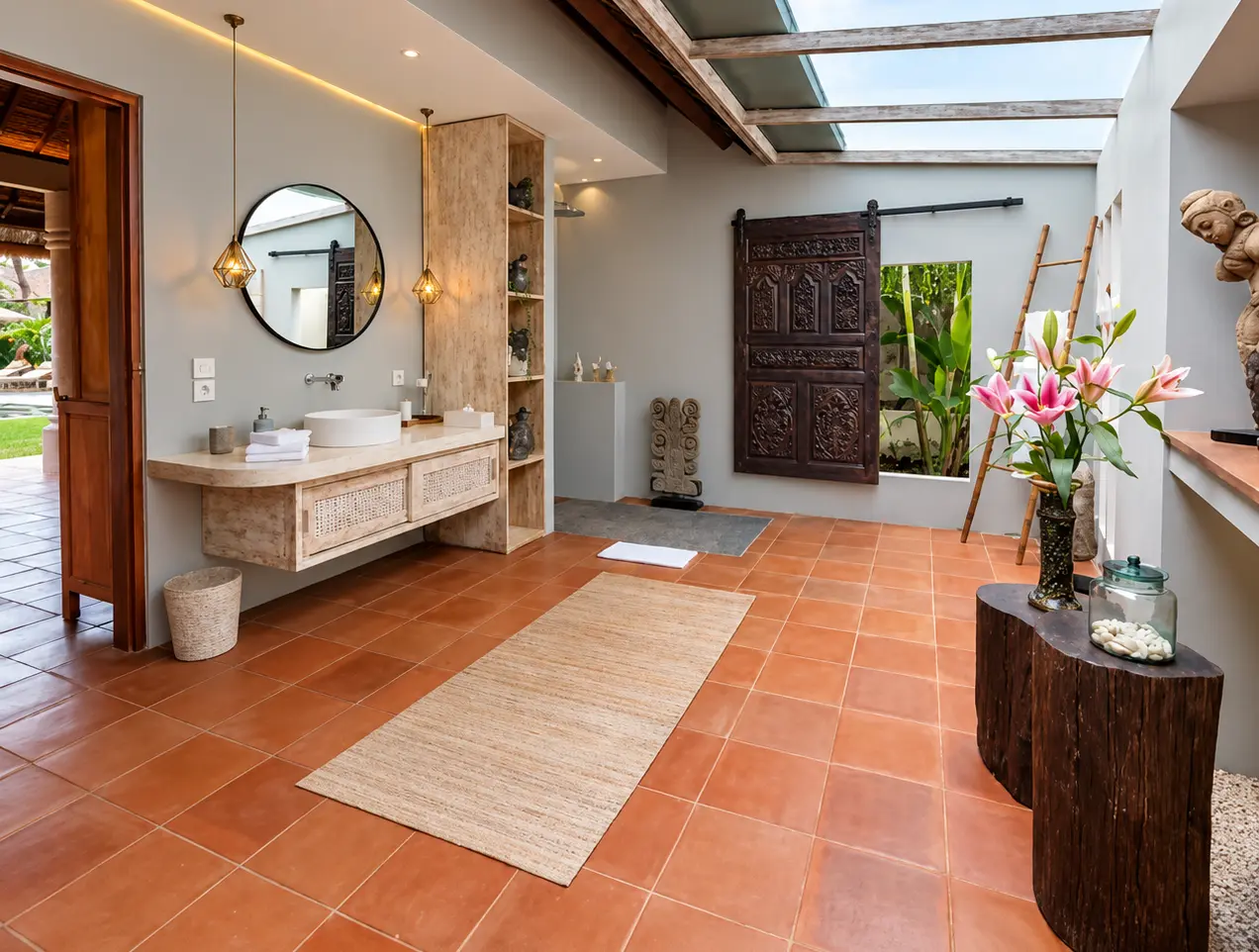
Advantages
- Warm natural colours
- Individual variation
- Handmade options available
- Develops character with age
- Works particularly well with timber and natural stone
- Suitable for traditional, Mediterranean and tropical designs
- Can create a softer appearance than highly manufactured tiles
Traditional clay and terracotta are generally more porous than porcelain or sintered stone. Depending on the product and application, sealing may be required to protect against moisture and staining.
Colour variation should also be expected. For handmade tiles, differences between pieces are generally part of the intended appearance rather than defects.
Best suited to: tropical villas, courtyards, terraces, kitchens, living spaces and projects seeking a warm, traditional or handcrafted appearance.
Cement Tiles
Cement tiles are manufactured using cement, aggregates and pigments rather than being fired like porcelain and clay.
They are particularly well known for decorative patterns and colours and can become an important architectural feature rather than simply a floor covering.
Traditional manufacturing creates a pigmented surface layer within the tile, giving cement tiles their distinctive appearance and allowing them to develop a natural patina as they age.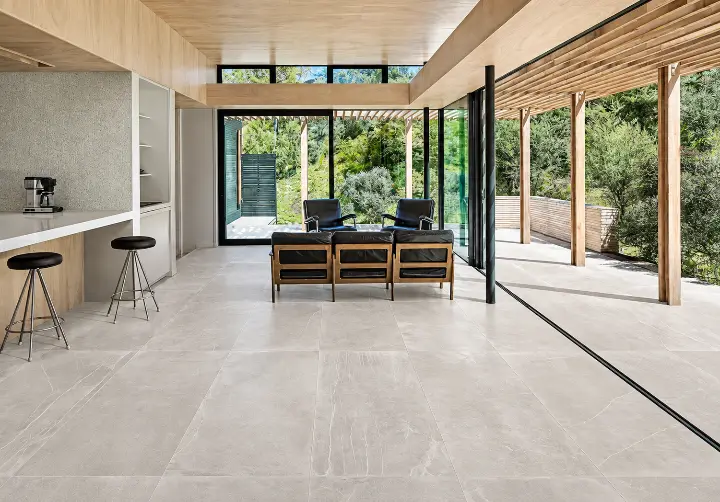
Advantages
- Large variety of patterns
- Strong architectural character
- Custom colours and designs can be possible
- Suitable for traditional and contemporary interiors
- Excellent for feature areas
- Handmade appearance
- Develops character with age
The main consideration is porosity.
Cement tiles normally require appropriate sealing during installation and may require maintenance thereafter. Acidic cleaners and aggressive chemicals can also damage the surface.
They aren't usually selected because they require the least maintenance—they are selected because of their colour, pattern and character.
Best suited to: bathrooms, kitchens, cafés, restaurants, entrance areas and decorative feature floors.
Natural Stone Tiles
Natural stone differs fundamentally from the other materials because its appearance wasn't created by a manufacturing process.
Marble, limestone, granite, travertine, sandstone, andesite and other stones are quarried from naturally occurring deposits before being cut and finished into tiles or slabs.
Variations in colour, fossils, pores, veins, mineral deposits and texture are all possible.
No two pieces need to be exactly alike.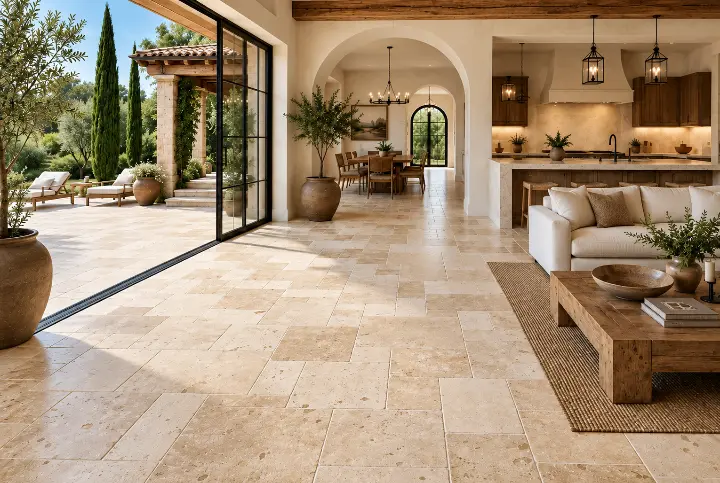
Advantages
- Genuine natural material
- Unique variation between pieces
- Wide choice of stone types
- Multiple surface finishes
- Can develop attractive character with age
- Particularly suited to tropical architecture
- Excellent integration with landscaping
- Some stones can be refinished during their service life
The important point is that natural stone isn't one material with one set of characteristics.
Granite, marble, limestone, andesite and sandstone behave differently.
Some stones have very low water absorption and excellent abrasion resistance, while others are comparatively porous. Marble and limestone can also be sensitive to acidic substances.
The stone therefore needs to be selected according to its intended application.
Best suited to: premium villas, swimming pools, bathrooms, terraces, façades, pathways, landscaping and projects where authentic natural texture is important.
How Do They Compare?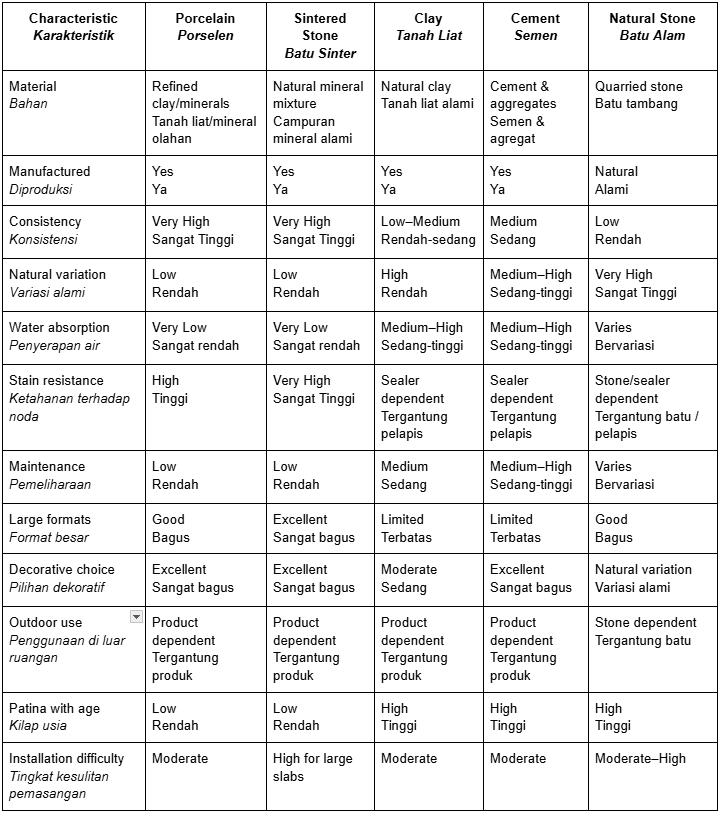
The table should be treated as a general guide. Individual products and stone types can perform differently, so technical specifications should always be checked for the intended application.
Which Should You Choose?
There isn't one winner.
Choose Porcelain if you want versatility.
For many projects, porcelain provides the best balance between price, durability, design choice and maintenance. It's particularly useful where you want a natural-stone appearance without natural stone's variation and maintenance considerations.
Choose Sintered Stone if you want large-format contemporary surfaces.
Sintered stone is particularly attractive when the design calls for large slabs, fewer joints, high performance and a very consistent architectural finish.
Choose Clay or Terracotta if you want warmth.
Clay works particularly well where slight irregularities and variations are desirable. A handmade terracotta floor can provide a completely different atmosphere from a precisely manufactured porcelain surface.
Choose Cement if the tile is part of the design.
Cement tiles are ideal when pattern, colour and handcrafted character are important enough to justify additional sealing and maintenance.
Choose Natural Stone if authenticity and individuality matter most.
If you want genuine geological variation, natural stone remains difficult to replicate. The challenge is choosing the right stone for the right application, rather than selecting purely by appearance.
What About Price?
Price should be considered as the installed system, not simply the cost per square metre of the tile.
A cheaper tile isn't necessarily the cheaper finished floor.
Depending on the material, the complete cost can include:
Tile or slab + transport + substrate preparation + adhesive/mortar + cutting + installation + grout + sealing + wastage + future maintenance.
Large-format sintered stone, for example, may require specialist equipment and installation. Natural stone may require sealing and additional sorting. Handmade clay can have greater dimensional variation requiring more installation time.
Porcelain may therefore sometimes provide a lower overall installed cost even when another material initially appears cheaper.
The Best Projects Often Use More Than One Material
There is no reason an entire villa or commercial development needs to use the same tile material.
A project could combine:
Porcelain for practical bathroom and internal floors,
Sintered stone for large-format feature walls and countertops,
Clay for warm living spaces,
Cement tiles for selected decorative areas,
and natural stone for pools, terraces and landscaping.
The objective isn't to determine which material is universally better.
It's to select the material whose appearance, performance, installation requirements, maintenance and cost best suit each part of the project.
Need Help Choosing the Right Tile?
Bali Building Solutions (BBS) can assist with sourcing and comparing porcelain, sintered stone, clay, cement and natural stone products for residential, villa, hospitality and commercial projects.